Meta Ad Library: Why a Brand's Ads Vanish, and Where to Look
How to find a brand's ads in Meta's free Ad Library, including the stopped ones Meta keeps. And how to spot the ads the brand is pushing hardest. We use Hume Health as the example.

Emils Veveris
Co-Owner @ Adyntel
Meta's Ad Library, also called the Facebook Ad Library, shows the ads running on Facebook, Instagram and Meta's other apps.
We're going to walk through it using one brand, Hume Health. It sells a health-tracking wristband and a smart scale that measures body fat and muscle.
Why this brand? Because it's been growing fast. In the US, Google searches for its name went from 27,100 a month in September 2025 to a peak of 110,000 in December. From February to August 2026 it's been 60,500 a month. That's more than double where it started.
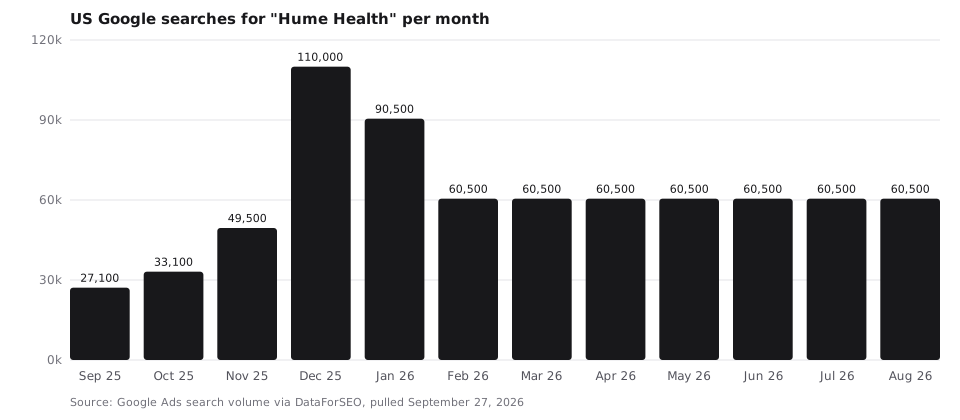
Monthly US Google searches for "Hume Health". Source: Google Ads search volume via DataForSEO, pulled September 27, 2026.
On September 27, 2026, Hume had about 4,600 ads running. But the library held about 31,000 of its ads. Most of them had stopped. Meta kept them because they ran in the UK or the EU. If Hume only advertised in the US, they'd be gone.
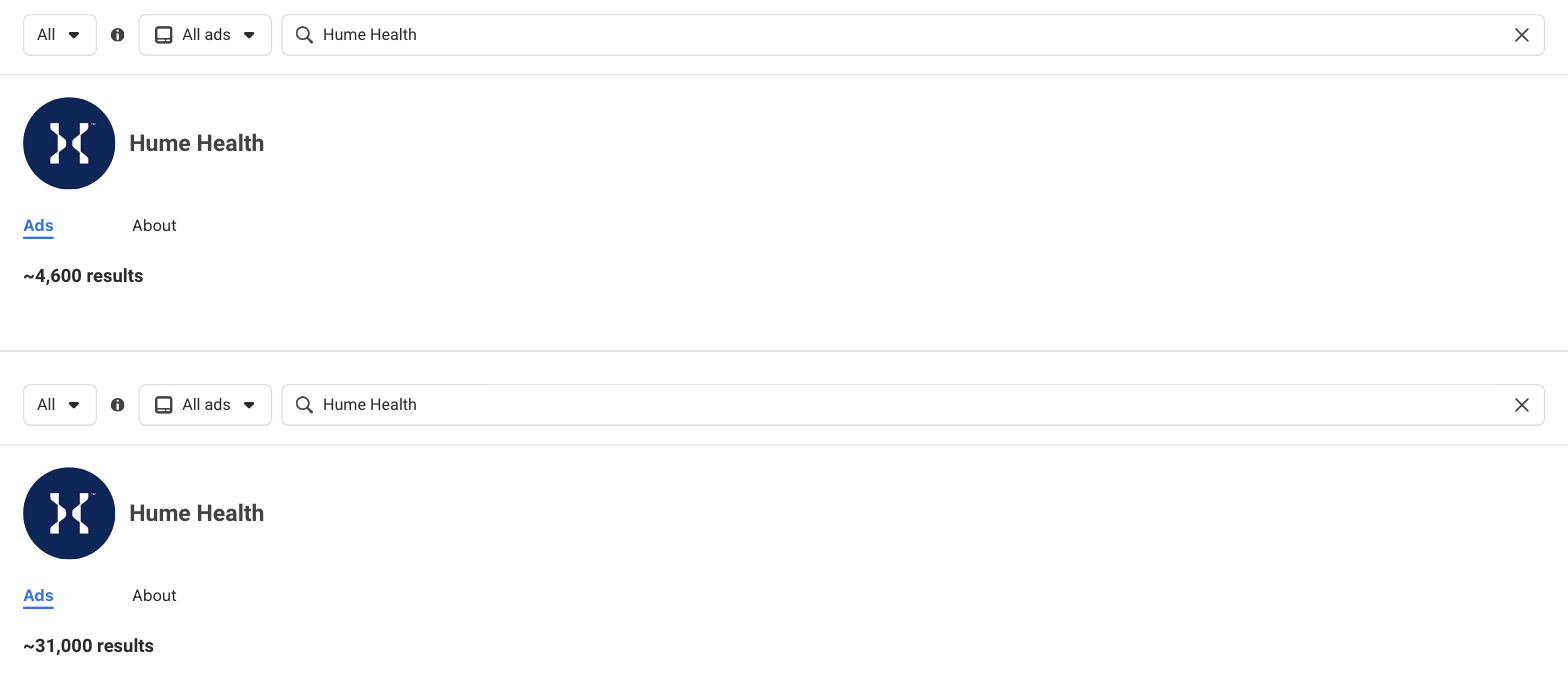
Hume's page with running ads only, then with stopped ads included.
Here's the plan. First we find Hume's ads and work out which ones Hume is pushing hardest. Then we find the ads Hume runs from pages with other names, and the ads that stopped. At the end, we cover what the library can't do, and compare Hume with its competitors using the Adyntel API. All counts are from September 27, 2026 unless we say otherwise.
Find one brand's ads
Two steps. Set the country and the ad category, then pick the brand's page from the dropdown.
Step 1: Set the country to All and pick "All ads"
The country box starts on the country you're in. Switch it to All. Then open the "Ad category" box and pick "All ads". The search box only works once you've picked a category.
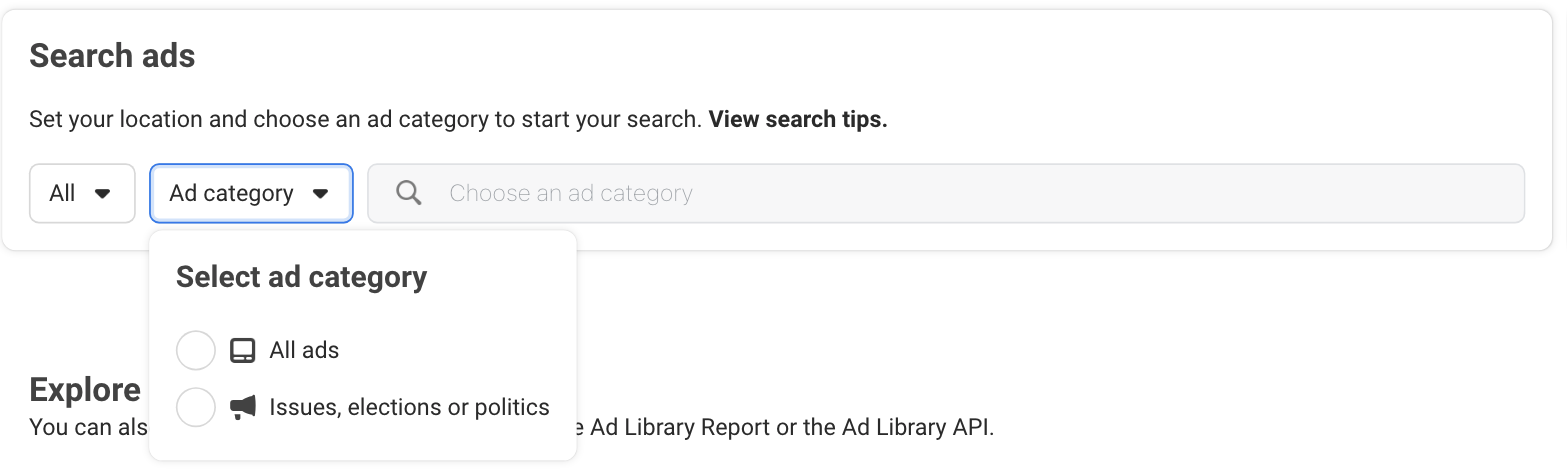
The two boxes to set before you search. The country goes to All. The ad category goes to "All ads".
Why All? Because the library only shows ads that ran in the country you pick. We're in Portugal, so a US brand with no ads in Portugal would look like it runs nothing.
Step 2: Type the brand name and pick its page from the dropdown
Type the brand's name, but don't search yet. Wait for the dropdown. Under "Advertisers", click the brand's page. If you're not sure which one it is, check the handle and the follower count. It should be the page the brand's website links to.
For Hume Health, that's @HumeHealth, with 58.3K followers on Facebook and 270.4K on Instagram. The others in the list are a gym, a nutritionist and a page called Loop - Hume Health.
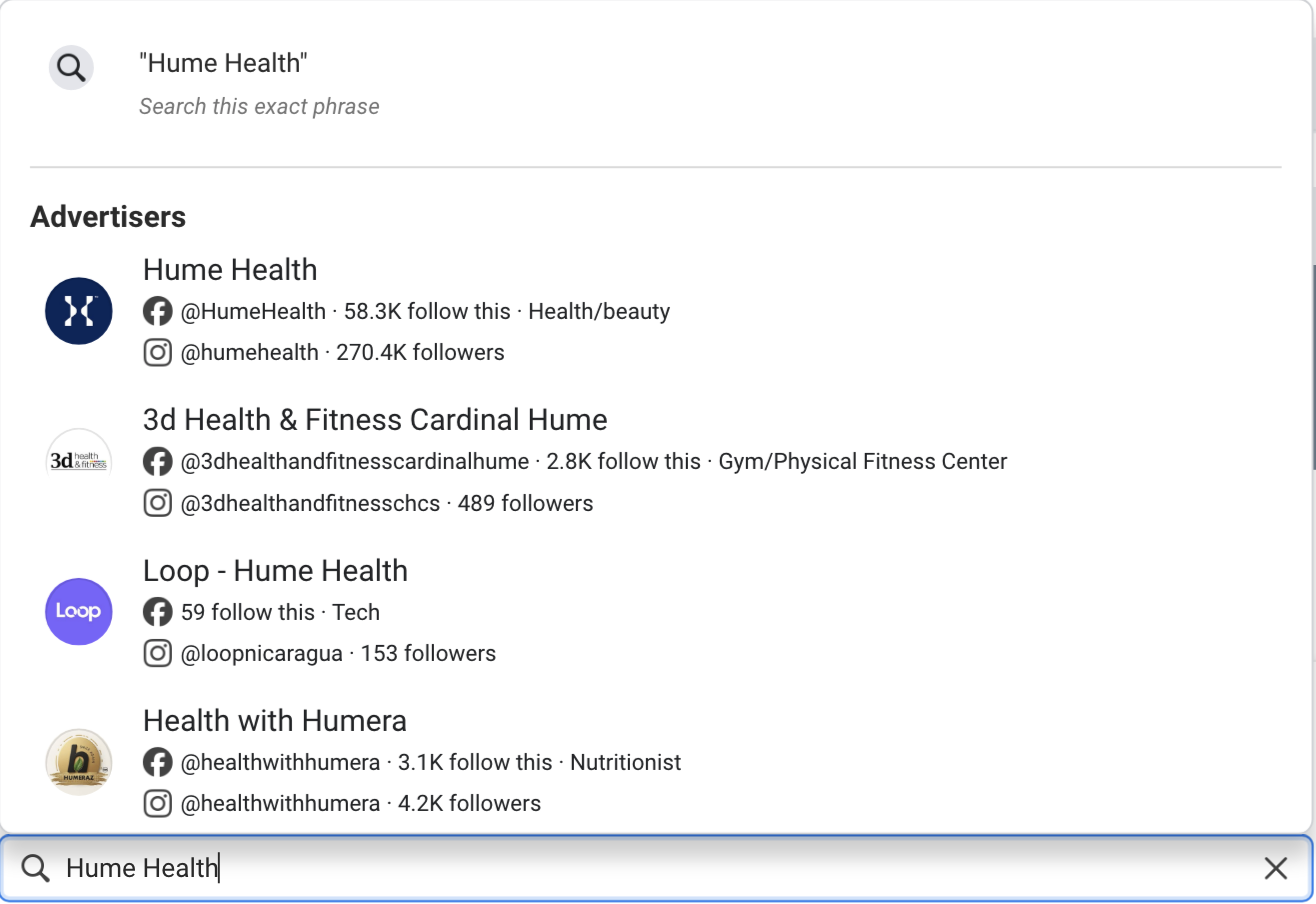
Click the brand under "Advertisers". Hume Health is the first one.
You should now be on Hume's page in the library, with a count of its ads at the top, like the top screen in the intro. The count said about 4,600. The library always rounds this number. Our API counted 4,607 the same day.
Note the web address. It now ends in view_all_page_id=107120738537338. That number is Hume's page ID. You'll use it later to check the API results.
What happens if you search by brand name instead
If you type "Hume Health" and search, instead of picking the page from the dropdown, you get every ad that mentions those words, from any advertiser. We tried it on September 28, 2026 and got about 5,800 ads. The day before, it was about 6,400. The count changes daily.
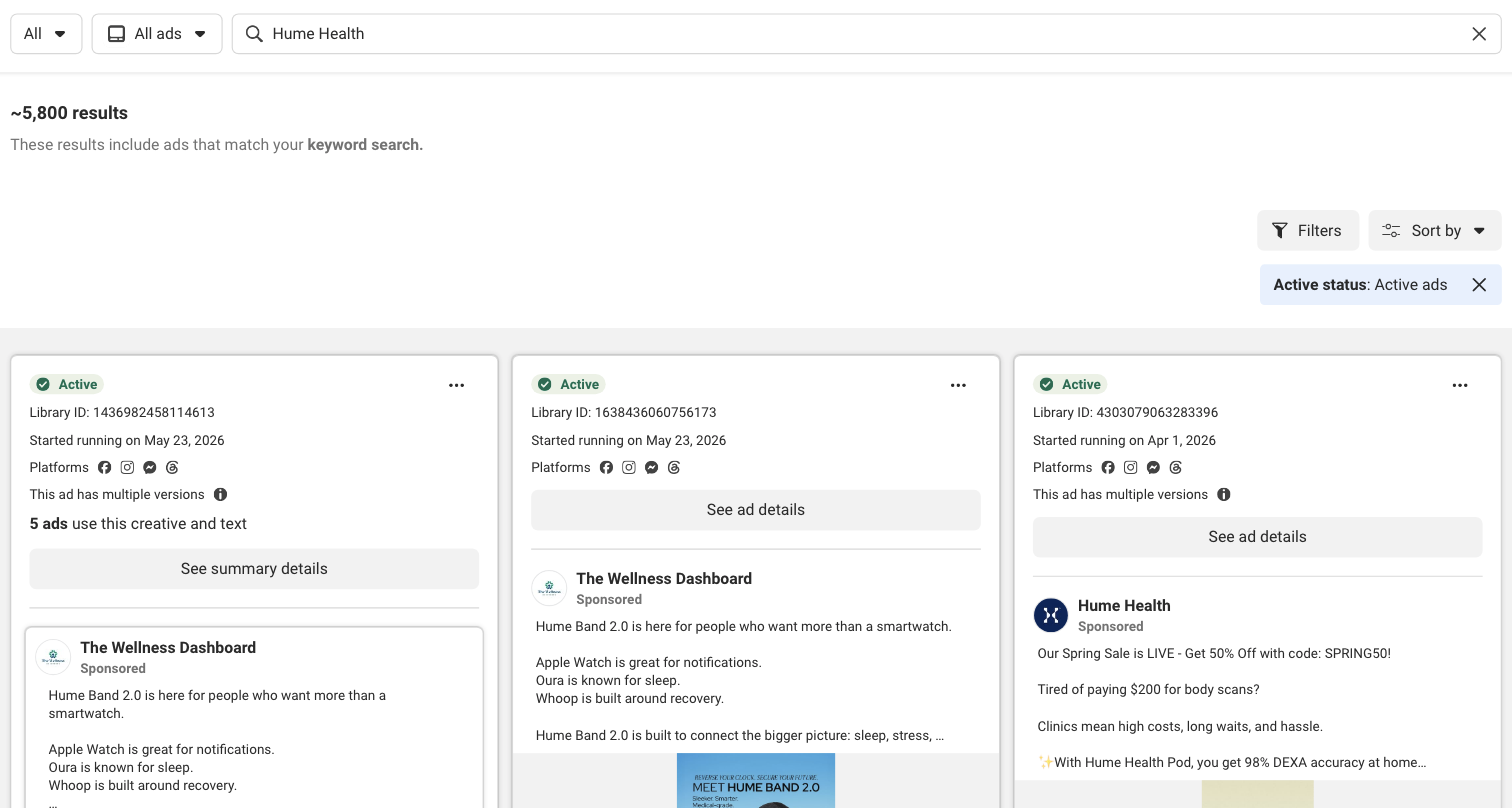
A search for the words "Hume Health": about 5,800 results. The first two ads come from a page called The Wellness Dashboard, not from Hume.
So a name search can't tell you how many ads a brand runs. But it's how you find the ads a brand runs from pages with other names. We get to those after the next section.
Which ads the brand is pushing hardest
So how do you tell which ads a brand is putting the most behind? The library gives you two clues: the order of the ads, and the reach on EU and UK ads. Two labels on the cards look like clues but aren't, so we explain those too. Go back to the brand's page.
1. The order of the ads
The library sorts ads by impressions, highest first. You can see that in the "Sort by" menu, which is set to "Impressions: high to low" by default. So the ad at the top is the one Meta has shown the most. The library just doesn't tell you how many times. The count runs from the day each ad started, so older ads have a head start. Leave "Sort by" as it is. If you switch it to "Most recent", you lose this order.
Here's the ad at the top of Hume's page. It's for the Hume Pod. It opens with "Our Spring Sale is LIVE - Get 50% Off with code: SPRING50!" and then asks "Tired of paying $200 for body scans?". It had been running since April 1, 2026, almost six months.
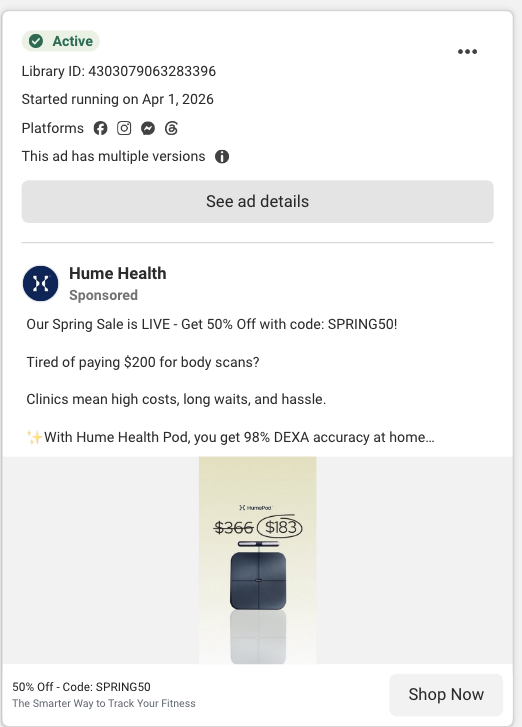
The first ad on Hume's page: the Hume Pod ad, running since April 1, 2026.
2. Reach, on EU and UK ads
Reach is how many people saw an ad at least once, split by country, age and gender. Strictly, Meta counts accounts rather than people, but it's the closest thing to an audience size you'll get.
Open a top ad with the "EU transparency" label and click "Transparency by location". On a card that says something like "3 ads use this creative and text", click "See summary details" first. The label is inside that summary. Under "Transparency by location", there are two sections. "EU ad audience" shows who the ad was aimed at. "EU ad delivery" shows the reach, with a table by country, age and gender. That reach only counts people in the EU. The UK gets its own tab.
Here's one of Hume's live ads. It runs from a page called The Wellness Dashboard, which we get to below. It reached 546,526 people in seven EU countries, and 76% were men. It also ran in the UK, where it reached another 650,439.
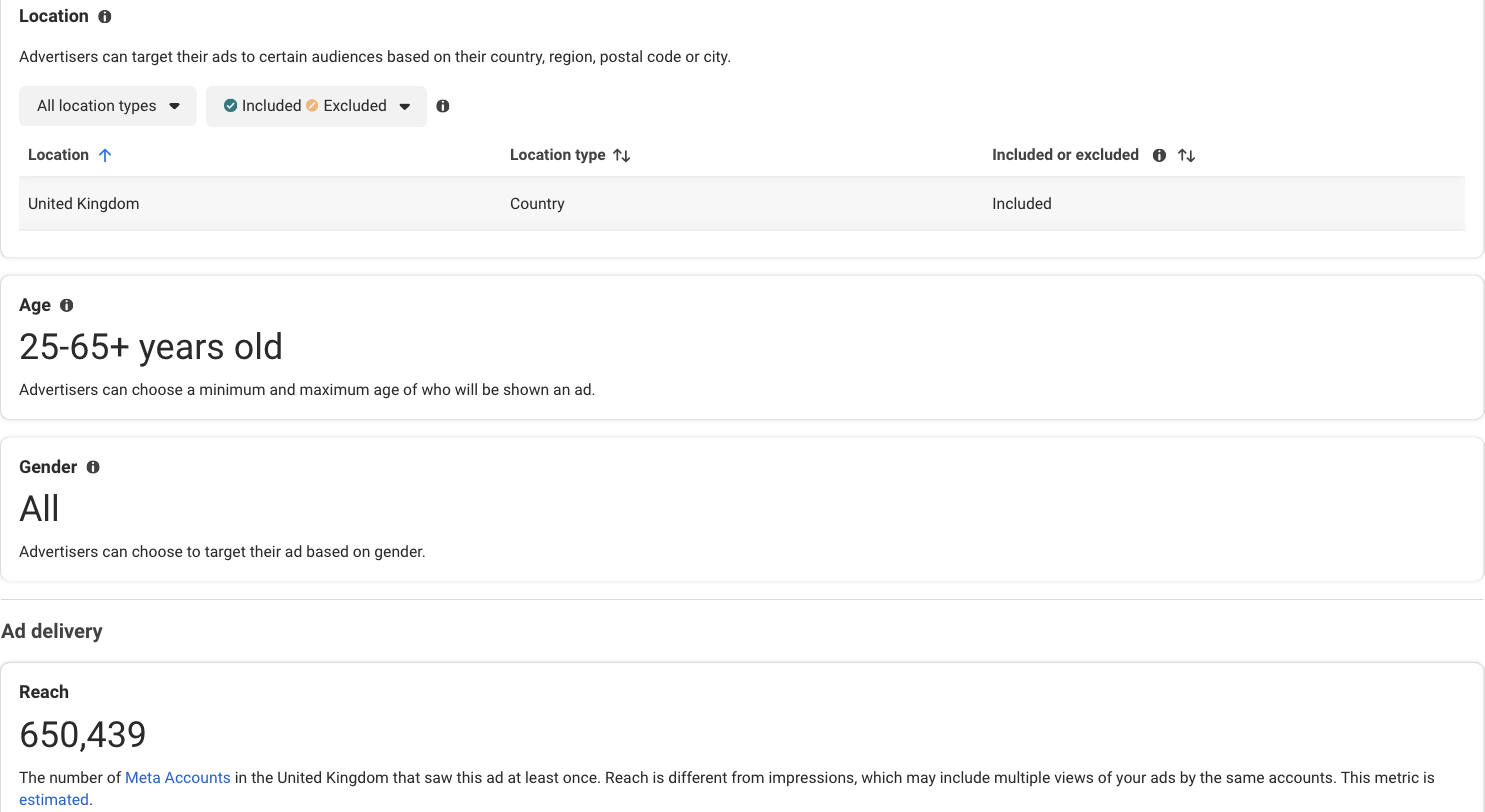
The UK tab of that Wellness Dashboard ad. It was aimed at people aged 25 to 65+ in the UK and reached 650,439.
A note on copies and versions
Two more labels show up on cards. They tell you how an ad is built, not how much money is behind it.
A card marked "11 ads use this creative and text" is the same ad running as 11 separate copies.
"This ad has multiple versions" means the advertiser gave Meta several images and several texts for one ad. Meta then shows each person whichever combination it thinks will work best. In our API this shows up as DCO, short for dynamic creative optimisation. Hume's top running ad, the Pod ad, is one of these.
Find the ads a brand runs from other pages
Some brands run ads from pages that don't carry the brand's name. Hume does. Those ads never show up on Hume's own page, so the count from Step 2 misses them.
To find them, search by the brand's name, as above. Scroll through the results and look for pages you don't recognise. Then check whether their ads link to the brand's website. For Hume, we found five: The Wellness Dashboard, The Daily Vital Check, The Health Baseline, Matt Evans and Well Well Wellness. All of them linked to humehealth.com.
Are those really Hume's ads? Open one of their ads with the "EU transparency" label. Click "See ad details" and expand "Advertiser and payer". If the card groups copies, click "See summary details" first, as before.
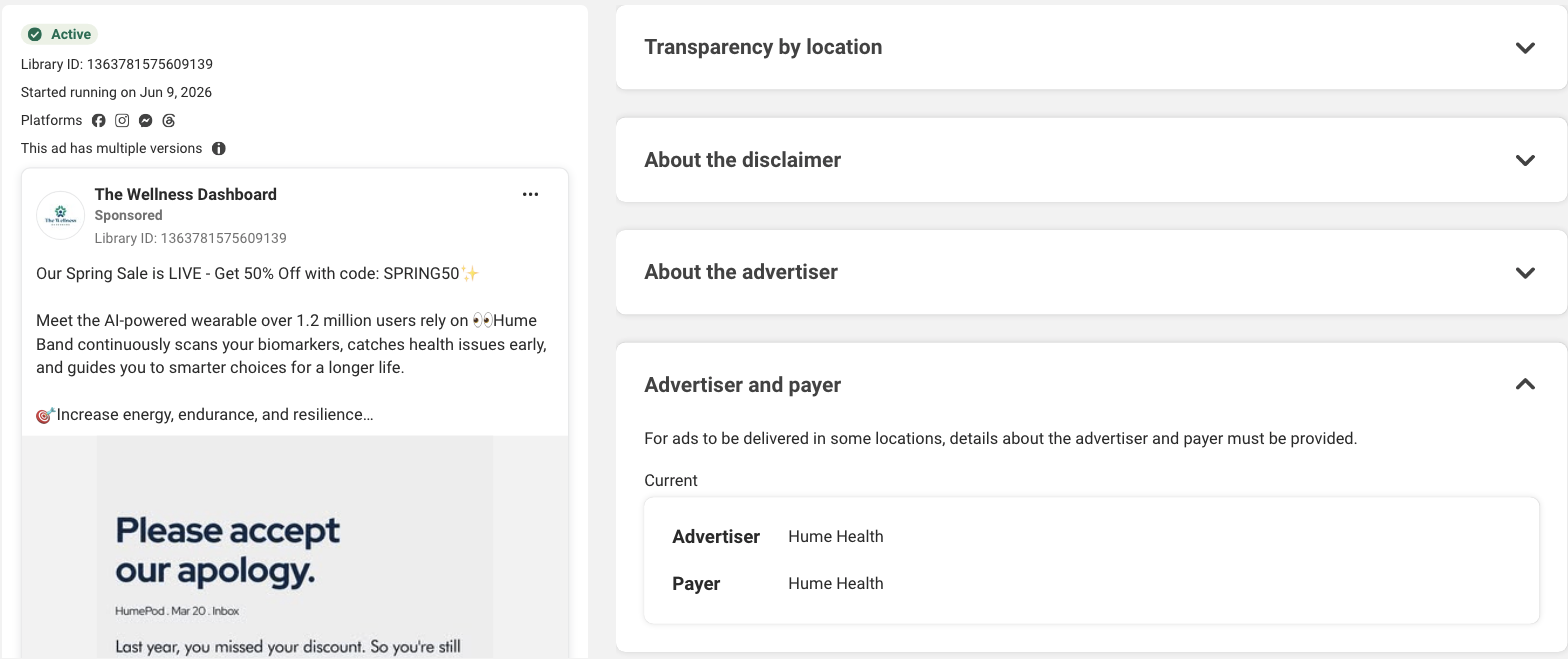
An ad from The Wellness Dashboard, paid for by Hume Health.
This check only works on ads that ran in the EU, because only those show who paid. For other ads, all you have is the link to the brand's website, and that doesn't prove who paid.
So Hume runs a lot more ads than its own page shows. Type The Wellness Dashboard into the search box and pick it from the list of advertisers, as in Step 2, and you get that page on its own: about 930 ads once you include the stopped ones. The library rounds that number too. Its ads also look different. The page calls itself a Medical Service, and some of its ads read like a customer review, in the first person: "That's why I've been using the Hume Health Pod. I step on, grab the handles…"
See the ads that stopped
Running ads only tell you what a brand is doing right now. Its stopped ads tell you what it did all year: the launches, the sales, the ads it kept running for months and the ones it dropped after days. The ones that ran for months are the ones that worked. Brands don't keep paying for ads that don't.
Go back to the brand's own page. It only shows ads that are running now. Click Filters and set "Active status" to All. Stopped ads show up as "Inactive".
Hume went from about 4,600 ads to about 31,000, the bottom screen in the intro. Our API counted 30,983.
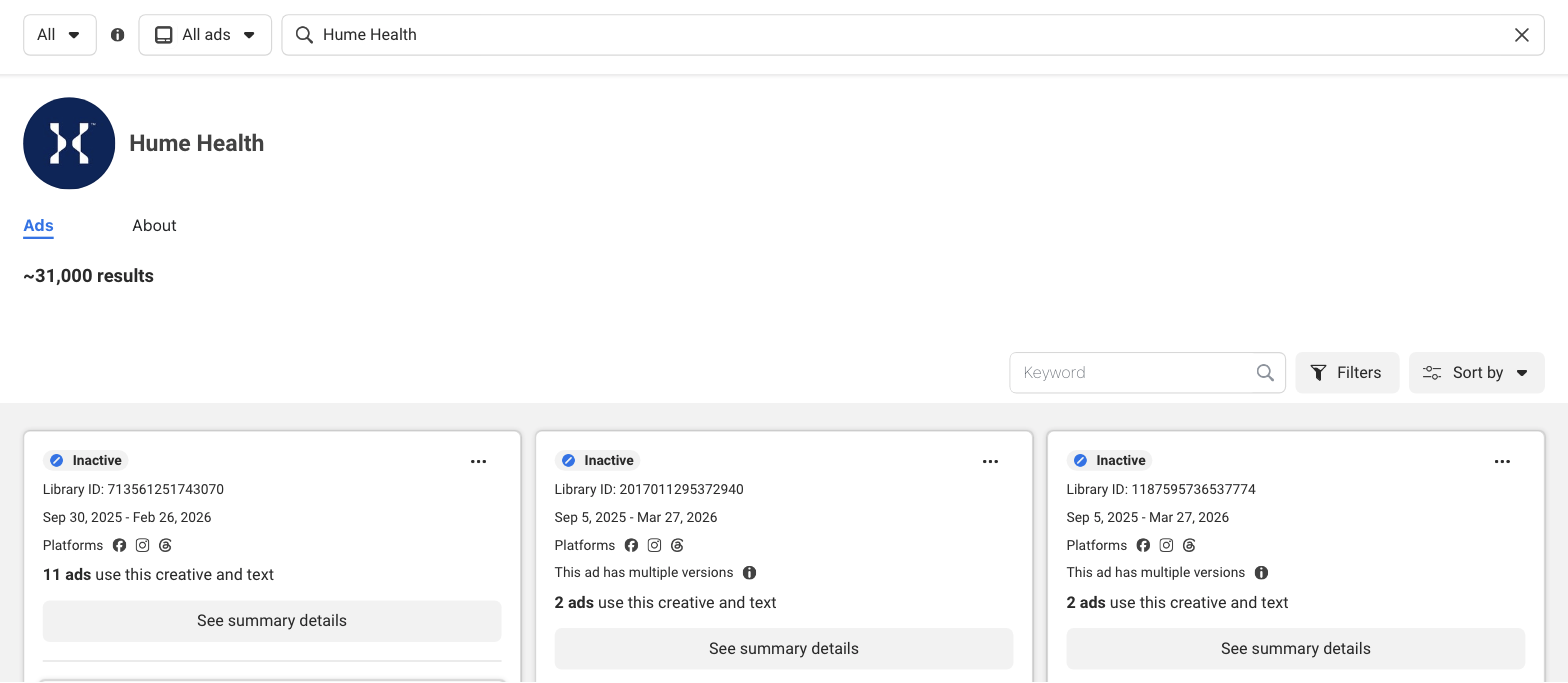
With Active status on All, the top three ads have all stopped. Their start and end dates are on the cards.
The first ad on the page is a Hume Band video. It ran for five months, from September 30, 2025 to February 26, 2026. The next two ran almost seven months, from September 5, 2025 to March 27, 2026.
Stopped ads keep their reach too. Open that Band video and click "Transparency by location". It was aimed at people aged 18 to 65+ in every EU country except Denmark, France and Sweden. It reached 2,353,120 people, and 60% were men.
The biggest country was Romania, with 363,726. Germany came next, with 285,978, then Portugal, with 254,453.
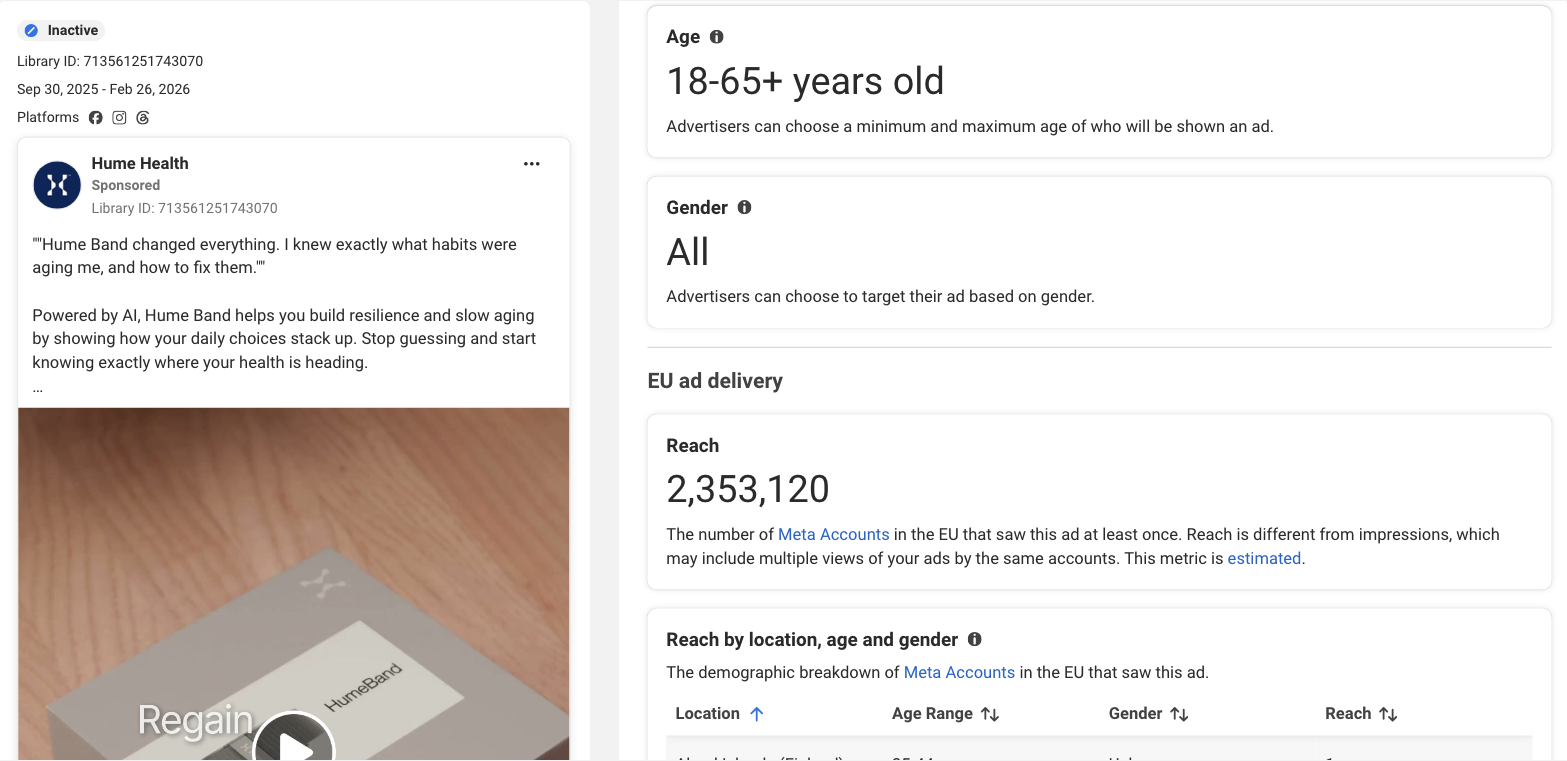
The stopped Hume Band video, with its EU reach.
So of all the ads on Hume's page that the library still holds, that video is the one Meta has shown the most. And its reach is the only number that tells you how big it got. You can't see that anywhere else.
It also ran as 11 copies. That's the "11 ads use this creative and text" label from the note above.
Hume advertises a lot in the UK and the EU, so about 26,000 of its stopped ads are still in the library. Now take a brand that hardly advertises in Europe. Uproot Clean sells home and pet cleaning products. It had no ads running in the UK and just 2 in Germany. Its count only went from about 1,800 to about 1,900. Once an Uproot ad stops, it's gone, unless it ran in the EU or UK. And with almost nothing running in Europe, there's almost no reach to look at. For a brand like that, the order of the ads is the best clue you'll get.
Where an ad ran also decides how much you can see about it. That's next.
What you can see depends on where the ad ran
Here's the whole picture.
| Where the ad was shown | Kept after it stops? | How many people saw it | Who it targeted | Who paid | How much was spent |
|---|---|---|---|---|---|
| The US, or anywhere else outside the EU and UK | No | No | No | No | No |
| The UK | Yes, for a year | Yes | Yes | No | No |
| The EU | Yes, for a year | Yes | Yes | Yes | No |
Take a US-only ad. While it's live, you see the ad itself and a short "About the advertiser" panel. Nothing more.
Political ads work differently. These are ads about elections, politics or social issues. They stay for seven years, wherever they ran. They show who paid. And they're the only ads that show how much was spent, as a range.
Why do EU ads get more? Because of an EU law, the Digital Services Act. It makes big platforms publish every ad shown in the EU. And they have to keep it for a year after it stops.
Follow the ads to their landing pages
Every ad links to a page, and that's where you see the offer and the price. At the bottom of most cards, you'll find the website in capitals, a headline and a button. Click the button to open the page. Some cards leave the website out, like the Hume Pod ad.
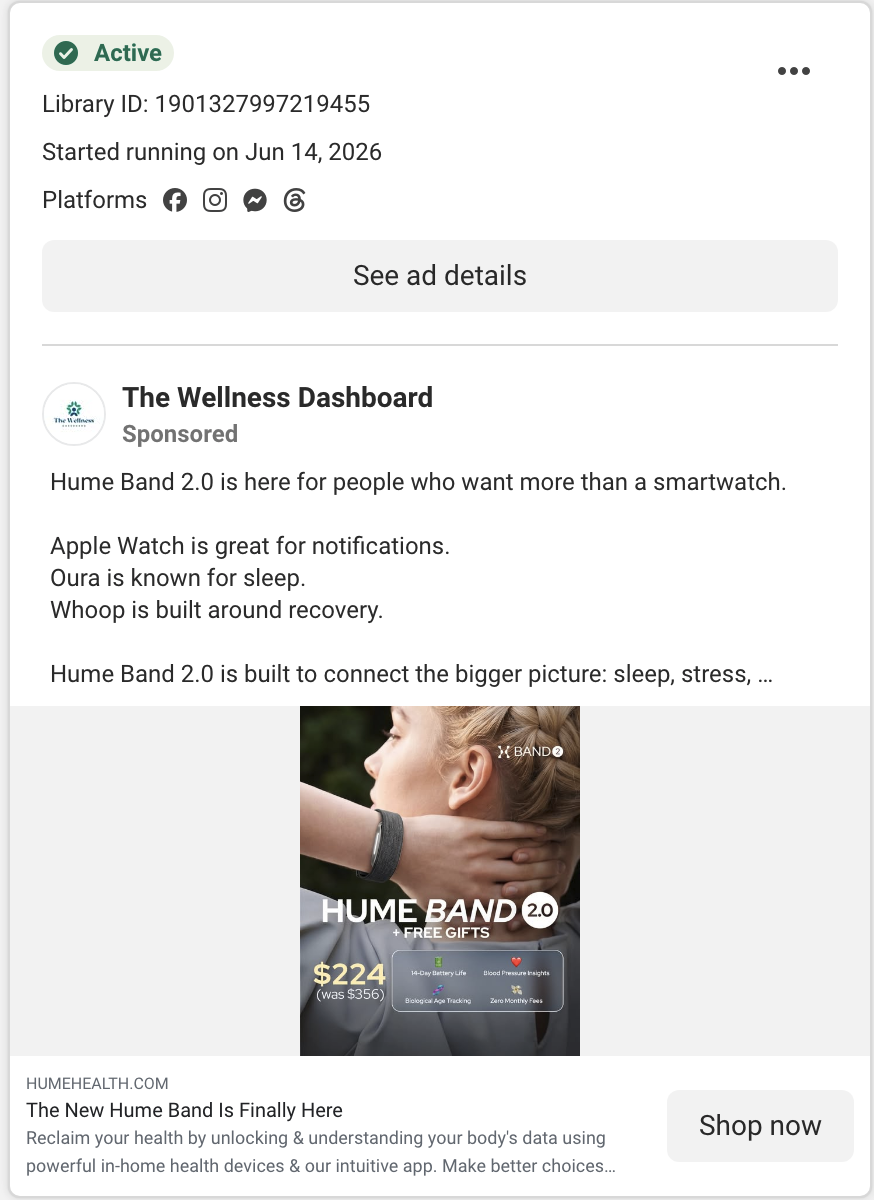
The bottom of a Wellness Dashboard card: HUMEHEALTH.COM, the headline and a Shop now button. The button goes to humehealth.com/pages/hume-bandv2.
Hume's ads send people to product pages on humehealth.com, one page per product. One of its German-language ads went to Hume's German site, humehealth.de. Uproot Clean's ads go to two separate order sites, order.uprootclean.com and cc.uprootclean.com, with a different page for each offer. Its first ten ads used four pages.
Most ads link to a specific page, not the homepage. On September 23, 2026, we pulled ads for 745 advertisers through our API. Of the 7,914 landing pages it listed, 93% were a specific page. Only 7% were a homepage.
Some ads show products from the brand's catalogue. Each product links to its own page. In the API these come back as DPA, dynamic product ads.
Spend figures: political ads only
Why only political ads? Because Meta chose to. It publishes spend and impressions for ads about elections, politics and social issues, and no law makes it do the same for ordinary ads. So it doesn't.
To see political ads, pick "Issues, elections or politics" as the ad category in Step 1. For US ads, set the country to United States. Click Filters and set "Active status" to All to include stopped ads.
Here's one ad from the DCCC, the Democrats' House campaign committee. It ran on Instagram only, for six days from August 28, 2025. The card shows $4K to $4.5K spent and over 1 million impressions. Open it, and you'll see that 53% of the people it reached were men between 18 and 24.
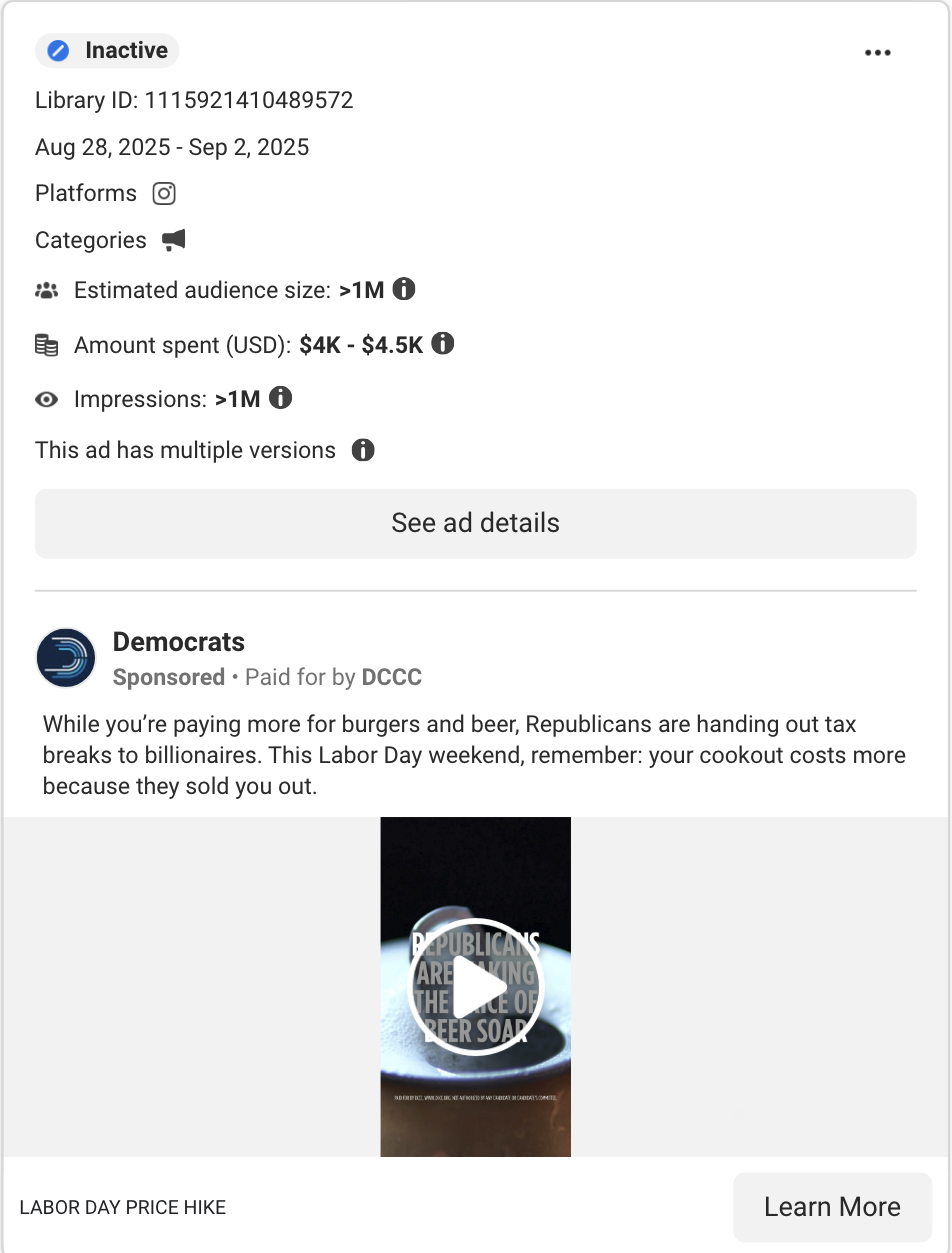
The DCCC ad's card: estimated audience size, amount spent and impressions.
For totals, use the Ad Library Report at facebook.com/ads/library/report. It covers political and social-issue ads by country, and you can download it as a CSV. US data goes back to September 2019.
Meta also labels housing, credit and employment ads as special categories, but they don't show spend either. We checked 702 of them through the Adyntel API on September 23, 2026, and none had spend data.
What the library won't give you
You can't download ads. If you're not logged in, the menu on each card has one option: "Copy ad link". The political Ad Library Report is the only export.
You can't search by website either. We tried typing a company's domain on September 23, 2026. It brought up unrelated pages. Our Meta endpoint does take a domain, which is what the API section below is about.
Meta has its own Ad Library API. But it only holds what the library keeps after an ad stops: political ads, and ads shown in the UK or EU. To use it, you need a Facebook account, a developer account, an app and an ID check at facebook.com/ID. Meta says the check can take a few days.
Do this for a list of brands with the Adyntel API
The library works one brand at a time. If you want to check 50 competitors, or your whole prospect list, use the Adyntel API instead.
You give it a website, like humehealth.com. It finds the brand's Facebook page and sends back the ads as data. For each ad, you get the text, the image and video links, the landing page, the platforms it ran on and the date it started. One call gets you the total ad count and the first ten ads. Ask for all the ads, and it keeps going until it has every one, however many there are.
Here's the call for Hume Health:
curl -X POST https://api.adyntel.com/facebook \
  -H "Content-Type: application/json" \
  -d '{
    "api_key": "YOUR_API_KEY",
    "email": "you@yourcompany.com",
    "company_domain": "humehealth.com"
  }'
And the start of the response, with one of the ten ads it returned:
{
  "page_id": "107120738537338",
  "number_of_ads": 4607,
  "results": [
    {
      "ad_archive_id": "4303079063283396",
      "page_name": "Hume Health",
      "is_active": true,
      "start_date_string": "2026-04-01T07:00:00.000Z",
      "publisher_platform": ["FACEBOOK", "INSTAGRAM", "MESSENGER", "THREADS"],
      "snapshot": {
        "display_format": "DCO",
        "link_url": "https://humehealth.com/pages/pdp3",
        "cta_text": "Shop now"
      }
    }
  ]
}
number_of_ads is the exact count. The page_id should match the number from Step 2. If it doesn't, the website links to a different Facebook page. That happened for under 1% of the 745 advertisers we checked on September 23.
What else you can do with it:
- Get the stopped ads too. For Hume, that's 30,983.
- Pick a country, or up to 20 countries in one request.
- Get only video ads, or only image ads, or only ads in one language.
- Find out which video ads are creator-style videos, the kind that look like a customer filmed them. Hume's first ten video ads held 17 videos, and 14 of them looked like that. Whoop, one of Hume's rivals, had 64, and none did.
- Get US political ads with their spend.
- Run a whole list. One call per website. Clay users add it as a column and run it down the table.
It won't give you reach, targeting or who paid. Open the ad in the library for those. And no spend, except on political ads, because Meta doesn't publish it.
You pay one credit for each successful call, even when the page has no ads. If no Facebook page can be found for a website, you pay nothing. So checking 200 brands costs at most 200 credits. That gets you each one's live ad count and first page of ads. New accounts get 50 free credits, no card needed. Plans are on the pricing page, and every setting is in the docs.
Compare Hume with its competitors
Hume's own ads name three rivals: Apple Watch, Oura and Whoop. We ran Oura and Whoop through the API on September 28, 2026, and added Withings and Ultrahuman, two other health-wearable brands. We left Apple out, because the API works from a website, and apple.com covers far more than the Watch. Hume's numbers are from the day before.
| Brand | Ads running | Ads in the library, stopped ones included | Running in the UK | Running in Germany |
|---|---|---|---|---|
| Hume Health | 4,607 | 30,983 | 1,756 | 871 |
| Whoop | 1,787 | 3,514 | 168 | 90 |
| Oura | 790 | 2,759 | 80 | 68 |
| Withings | 286 | 4,423 | 27 | 25 |
| Ultrahuman | 91 | 929 | 8 | 0 |
Hume runs more ads than the other four put together. It also runs ten times as many in the UK as Whoop, the next biggest. Withings has few ads running but a lot stopped, so over the past year it ran far more than it does now. Ultrahuman has nothing running in Germany.
That took 20 API calls, four per brand, one per column. In the library, it would have been 20 searches with the filters changed each time, and no way to save the numbers.
FAQ
Do I have to pay or sign in to use Meta's Ad Library?
No to both. Anyone can search it at facebook.com/ads/library without a Facebook account.
Does the Facebook Ad Library show all ads?
It shows every ad running right now. Once an ad stops, it drops out of the library, unless it ran in the EU or UK or was political. EU and UK ads stay for a year. Political ads stay for seven years.
Why does a brand look like it runs no ads?
Usually the country is set to the one you're in, and the brand doesn't advertise there. Set it to All. Or you searched by name instead of picking the brand's page from the dropdown. Some brands also run ads from pages with other names. The section on other pages shows how to find them.
Does the Meta Ad Library show spend?
Only for political ads, and only as a range. For EU and UK ads, reach is the closest number you'll get.
Can I download ads from the Meta Ad Library?
No. Logged out, the card menu only has "Copy ad link".
Is there a Meta Ad Library API?
Meta's own API only covers political ads plus EU and UK ads, and you need an ID check to use it. For any brand's live ads by website, use the Adyntel API.